Bed bug infestations in Central Florida thrive inside humid wall cavities, box springs, and electrical faceplates. In dense multi-unit properties across MetroWest and historic bungalows near Lake Eola Heights or…
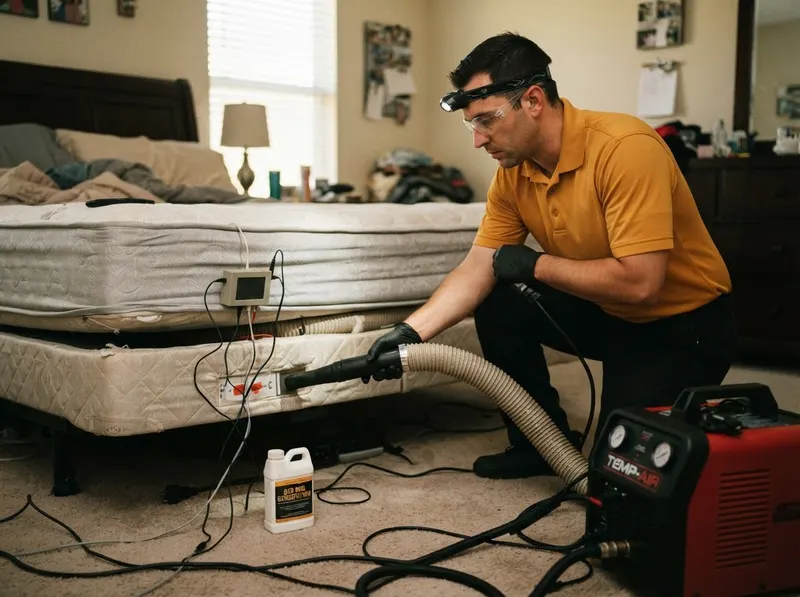
Bed bug infestations in Central Florida thrive inside humid wall cavities, box springs, and electrical faceplates. In dense multi-unit properties across MetroWest and historic bungalows near Lake Eola Heights or Thornton Park, single-modality sprays often fail because Cimex lectularius populations have developed documented physiological resistance to standard pyrethroids. Dual-modality remediation resolves this failure point: industrial convective air heaters raise interior ambient temperatures between 122°F and 135°F, denaturing the vital cellular proteins of bed bugs and their eggs within ninety minutes of sustained exposure. High-output axial air movers circulate this thermal energy behind baseboards, crown molding, and deeply tucked mattress seams where insects harbor.
While thermal remediation delivers an immediate kill across exposed materials, heat leaves zero residual defense once the structure returns to standard room temperature. A comprehensive protocol therefore pairs heat with non-repellent microencapsulated chemical insecticides and insect growth regulators (IGRs) placed along perimeters, plumbing penetrations, and structural thresholds. If a property is a single-family residence in Baldwin Park, College Park, or Doctor Phillips with an active multi-room infestation, whole-home thermal treatment paired with perimeter residuals offers maximum immediate clearance. If the issue is an isolated hotel room, vacation rental near Conway, or a low-density apartment in Lake Nona, localized chemical desiccant dusts and liquid spot treatments provide a targeted approach without the high power draws of whole-structure heaters. The technical trade-off is equipment footprint versus treatment duration: thermal remediation requires heavy generator drops and 6 to 8 hours of structural vacancy, whereas localized chemical programs require two to three staged visits spaced 14 days apart to break the egg-hatch cycle.
Technicians dispatched across Orlando operate under Florida Department of Agriculture and Consumer Services (FDACS) licensing standards, deploying calibrated digital thermal sensors inside heavy furniture cushions and deep closet spaces to verify lethal heat penetration. Treatments are engineered to withstand Orange County humidity levels, using silica-based dusts and moisture-stable residual suspensions in structural voids to ensure long-term barrier integrity. Dispatched technicians arrive directly in company-branded service vehicles, eliminating third-party contractor uncertainty and unexpected setup fees. Dialing (239) 695-8603 initiates scheduling for full-property visual inspections, thermal sensor planning, and customized remediation protocols.
Every job gets a firm, written price after a free on-site visit.
Tell us about your bed bug heat and chemical remediation job in Orlando and we'll send a clear, written quote, usually the same day.
 Yellow Jacket Pest Control